Britain is leading the charge in the ominous computers of the future
Read more below: frankwolfreysportfolio.blog
[image or embed]— Frank Wolfreys (@citystgeorgesasses.bsky.social) 30 March 2026 at 12:57
On the ground floor of computing giant IBM’s offices in Waterloo, the company who created but failed to patent the classic computer has a model displayed of a quantum computer – it’s second stab at technological domination. Eyes goggling it through thick glass would be forgiven for thinking that the ‘the future’ looks remarkably similar to the past.
Despite the Tardis- like nature of this hardware, however, the promise of the technology has attracted investment from the government with its promise of indescribable change.
Earlier this March, the UK’s Chancellor delivered her Mais lecture to set out an economic vision to business players and thinkers. In it she pledged £1 billion to support the development of the first quantum computers. In doing so, she positioned Britain’s quantum success as a key part of her economic vision for the future.
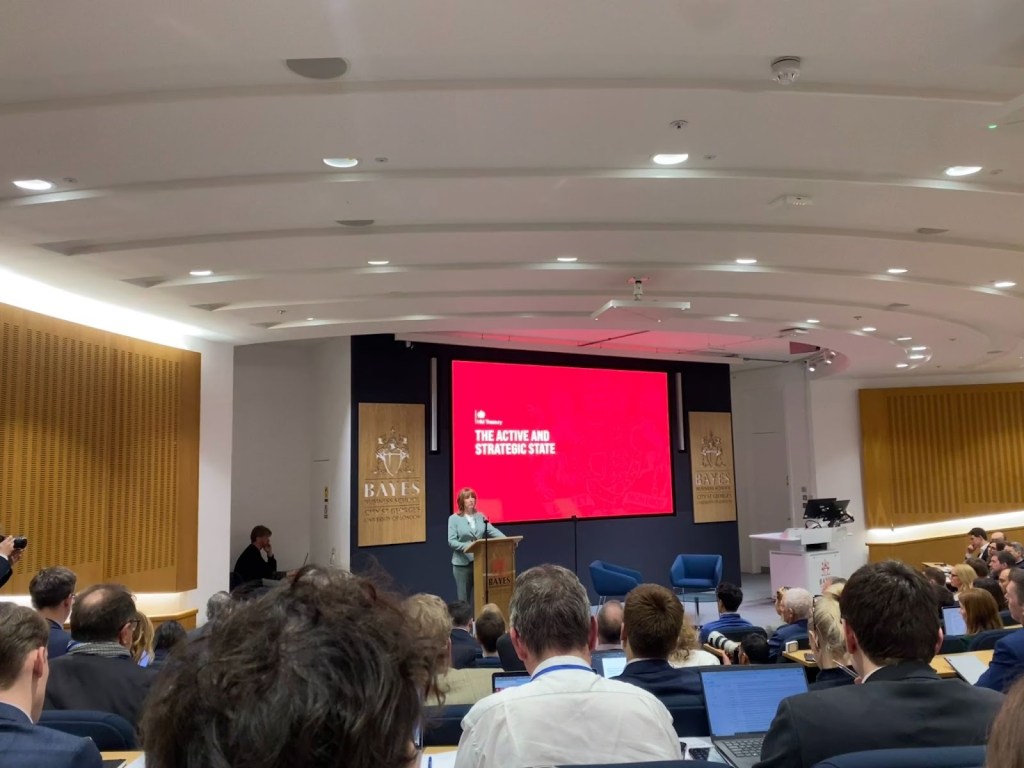
Rachel Reeves delivering her second Mais lecture to a group of experts and journalists at Bayes Business School, Credit: Frank Wolfreys
Even the most exuberant of quantum optimists, though, admit that any such active application or use of a quantum computer is most likely a decade away.
In what is a deeply theoretical field, quantum professors are propelled by imagining how quantum computing can solve the world’s problems.
Winfried Hensinger, a leading quantum professor at the University of Sussex, explains that the rapidity of which quantum computers can target significant problems – such as finding the chemical makeup of a vaccination – spurs him on.
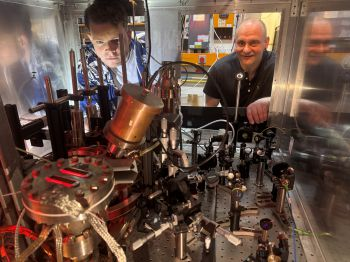
Winfried Hensinger with his colleague with the trapped-ion quantum machine capable of measuring electric fields with unparalleled accuracy, Source: University of Sussex
“There would be nothing cooler than when I’m dead and on my grave, and, it says, this man has helped to accelerate the creation of this drug that really helped these people who would otherwise have died,” he said.
But how much of the QC industry is based on visions and hypotheses? Given its early phase, the answer is a significant chunk.
QCs are made from quantum chips which require qubits – very precise combinations of alloys made through a lithographic process. The subsequent firing of the machine requires very specific isolated conditions, which involves getting the space down to the coldest possible temperature.
For a quantum computer to fire a particular problem, a particular algorithm has to be found for that problem, a situation which has led previous enthusiasts to have left the profession.
Dr Mithuna Yoganathan studied Quantum Computing at the University of Cambridge and now runs a Youtube channel which aims to boil down the actual progress of QCs. She said she left her studies because of the frustration at the lack of progress in locating algorithms.
As a former insider, she believes that the progress made by academics and researchers to locate these golden algorithms in the past few years has been “very slow.”
In an industry running off hope and possibility, any promises about the future are controversial.
Sussex’s Hensinger admits that the process can often be messy and that often very expensive mistakes occur.
“Quantum computing has truly groundbreaking applications, but, but but it’s very important to understand that it will take time. And, you know, there is no there’s no trickery or magic or whatever these things, this will take time”
Hensinger has an effusive optimism. He says that people telling him something is impossible makes him want to try.
However, it doesn’t require such potent optimism to acknowledge that Britain has an enviable position to stand to benefit from the fruits of QCs which may transpire.
At the University of Sussex, a vacuum technology was last year created which made Britain one of only three other countries with the technology.
The vacuum allows a protected space for what are highly sensitive particles to conduct much more efficient and fast quantum reactions.
Alongside this hope, what Reeves termed in her Mais lecture as the Silicon Valley of the north has shown signs of competitive successes.
Hensinger is driven not just by the ability to help cure diseases and save the world, but also by a fierce competitivity with his rival quantum research department at Oxford:
“We didn’t get funding for that, like all the funding went to our competitors in Oxford and and so be like, you know, and we just found money in all sorts of funny places fit this on a shoestring budget and and a Few years later, we beat Oxford an order of magnitude and speed, and by a million, we reduce the error by a million, so we make this so much more powerful.”
Quantinuum is a world leading British company which has one of the most advanced trapped ion systems.
But, as well as the possibilities to cure disease and solve the energy efficiency problems of the future which the world is set to face with climate change, the discussions about the damage a working QC could do is also a hot topic.
Last week, Google wrote a blogpost warning that: “The encryption currently used to keep your information confidential and secure could easily be broken by a large-scale quantum computer in coming years.” This very real possibility that a sufficiently powerful QC could break the encryption on virtually all classical computers, meaning all online data – including credit card details, addresses and passwords – would be corrupted has been dubbed “Q-Day”.

IBM’s decommissioned early quantum model displayed in the ground floor of its office in Waterloo Credit: IBM
With the realisations of QCs to be determined, it is those like Hensinger, who are trying to make the theoretical practical by pursuing the impossible, who will decide whether it will happen. And, inevitably, the actual practicalities of solving what has been created from this are invariably relegated, perhaps dangerously, to tomorrow’s problem.
It is the continued work of researchers like Winfried Hensinger, who are driven to make the theoretical practical, will ultimately determine whether it becomes reality.
It is likely that theorists and thinkers across Britain and Europe, where the quantum charge is being led, are motivated by a similar balance of a desire to be the best and to help the world.
As their bids to unlock the real world implications of their theories remain ongoing, however, just who will be responsible for these remains perhaps ominously unclear.
1042 words
Sources:
Winfried Hensinger, W.K.Hensinger@sussex.ac.uk>
 Site Title
Leave a comment